
Evans is widely known as Canada’s pre-eminent colourist. Evans wanted his paint to be “within the canvas, not sitting on its surface, like a tattoo”, he said.

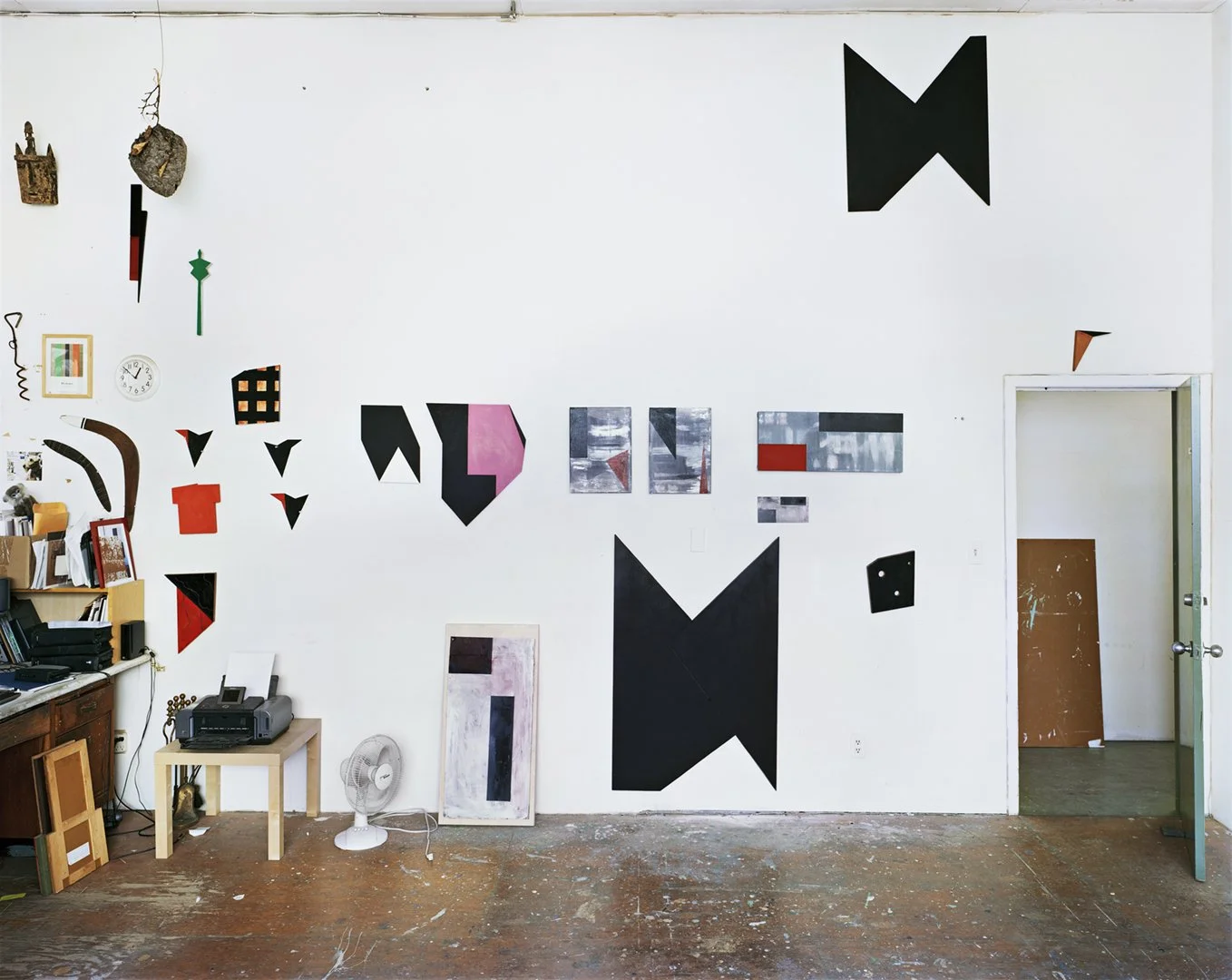
But to leave it there would be to miss something essential: Ric Evans made studios. Transforming Ric’s Studio, Studio 201 into the Ric Evans Studio has been like his paint —the soul of the artist - tattooed on the physical space, not merely occupying it.

The studio was where Evans made art for 55  years.  An empty room that got filled with thoughts until it was no longer empty. A place where objects and ideas could collaborate and share their secrets with the maker. As a teenager, Ric dragged his materials down to the basement and set himself and a friend beside the furnace, painting and listening to music. He declared himself an artist quickly while attending OCA in 1967-68.
Evans became an emerging artist of recognition, after settling into a dedicated studio practice.

Independently showing at Toronto’s first artist cooperative - ACT, Artist Cooperative of Toronto, 424 Wellington St., Toronto, created by artists determined to have their own work/live arrangement to manage costs and showcase their work without gallery representation

The artists gained confidence, ACT attracted with Toronto’s memorable parties filled with characters.  He built downtown studios @ 10 Niagara Street, 424 Wellington Street, 10 Duncan Street, 253 Niagara Street. The views out his studio windows changed but the visual combinations were an endless source of inspiration.

The objects accumulated over decades. Stamps collected since childhood. Art books, 45’s, cassette tapes and CD’s of a lifetime of listening to jazz, piano instrumentals, horns, voice, R&B, blues, classical. A mask and boomerangs from foreign lands. Pieces of driftwood. Small glass objects. A silver branch presented as a wedding present combined with a plant. 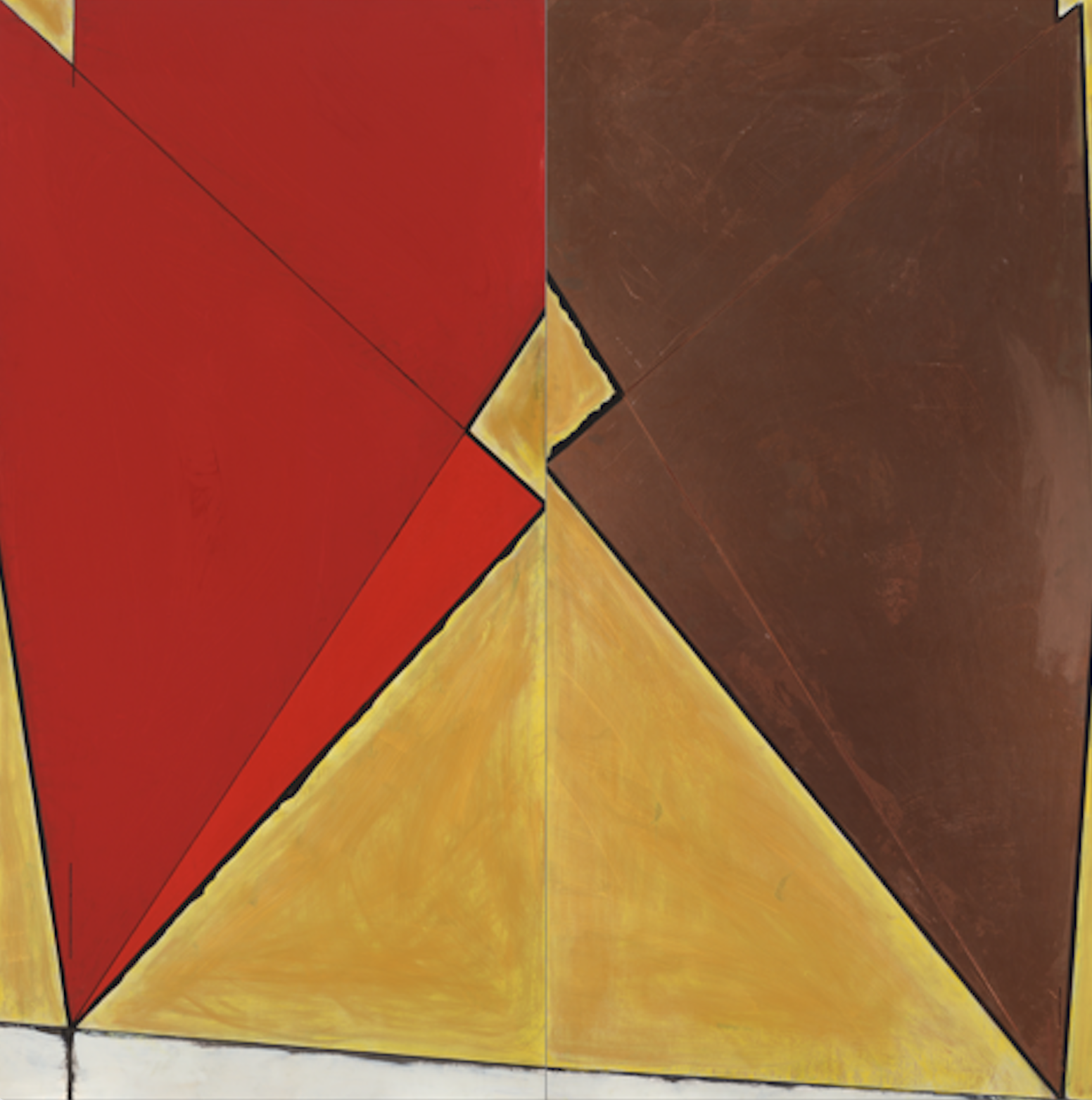
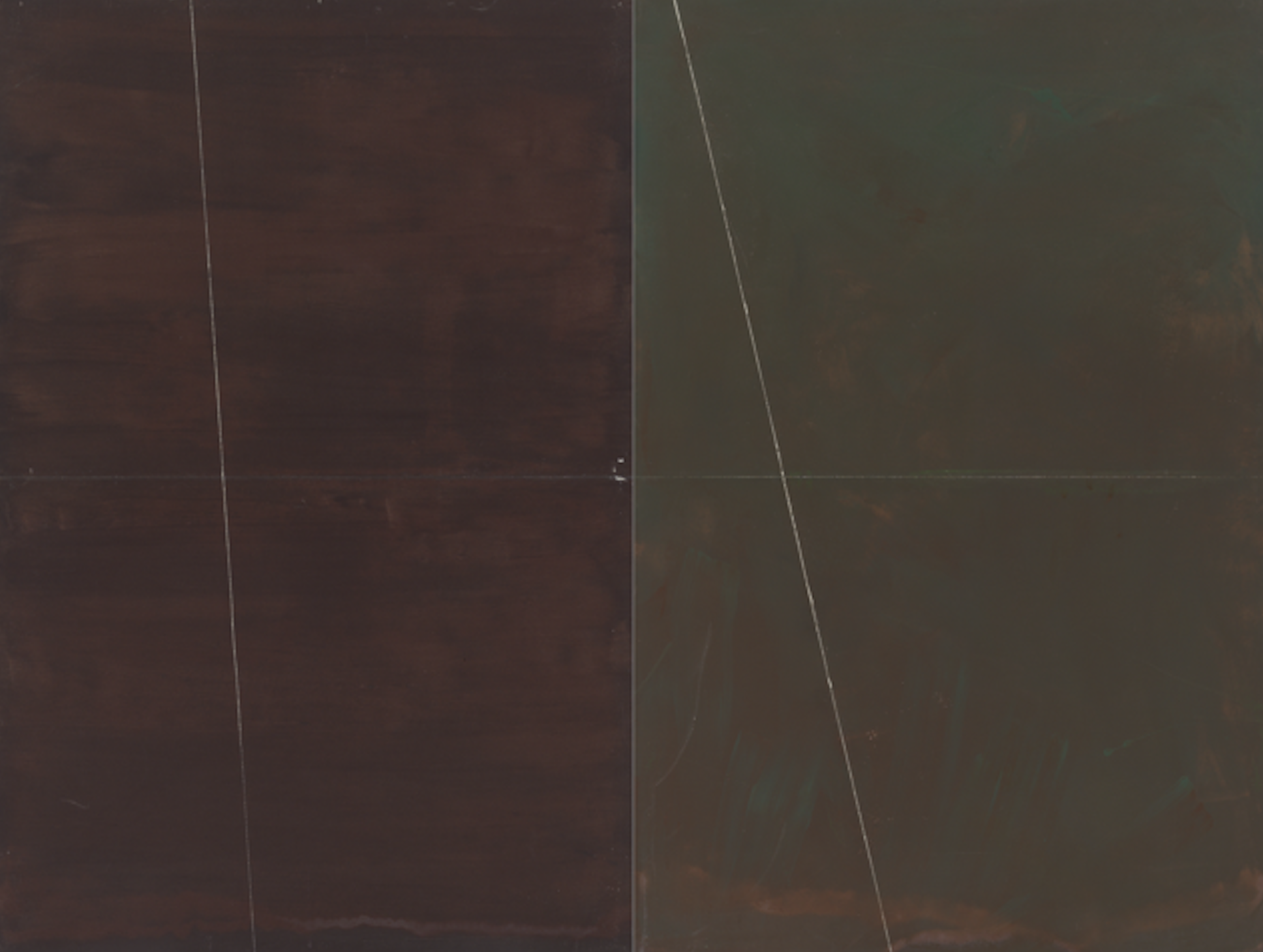
In 1975, Evans systematic and constructive oil paintings were featured in a major group exhibition at the Art Gallery of Ontario, further cementing his reputation as a leading figure in Canadian abstract art. The 1975 AGO group show simply entitled Four Painters asked Evans to describe his work. He gave the facts, "Ric Evans paints 6 inch vertical bands of artist's oil colour on a ground of latex interior house paints, on canvases 3 ft. by 6 ft." The group defined their common ground as "reduced means, serial format, denial of illusion and illustration." No mystification, no grand claims. Just the work and its materials.

The Art Gallery of Ontario purchased two paintings by Ric Evans entitled Common Cents, 1973 - 1976 and Flux II, 1980.
Ric was actively involved in the artist-run movement in the 1970’s that transformed  contemporary art in Canada. He exhibited with the Toronto Artists’ Cooperative (ACT) at 424 Wellington Street and was one of twelve founding artists of Mercer Union - an artist-run centre - that remains a cornerstone of  Canada’s contemporary art landscape. For more information on artist run cooperatives in Toronto browse Collective City archives.

In the early 1980s, Evans exhibited with Ydessa Hendel’s Gallery and Glendon Gallery in Toronto, the Alberta College of Art, and the Institute of Contemporary Art in Sydney, Australia.

From 1983  to 1988, he exhibited with Grunwald Gallery before joining Sable Castelli Gallery from 1989 - 2004. In 2005, Ric joined Nicholas Metivier Gallery who recently exhibited “Concordia Harmony” and “Overview“ in a 2026 group show entitled SHIFT.  Nicholas Metivier Gallery has been exhibiting Ric Evans new art work for over two decades and has represented Evans at the Art Toronto fair.
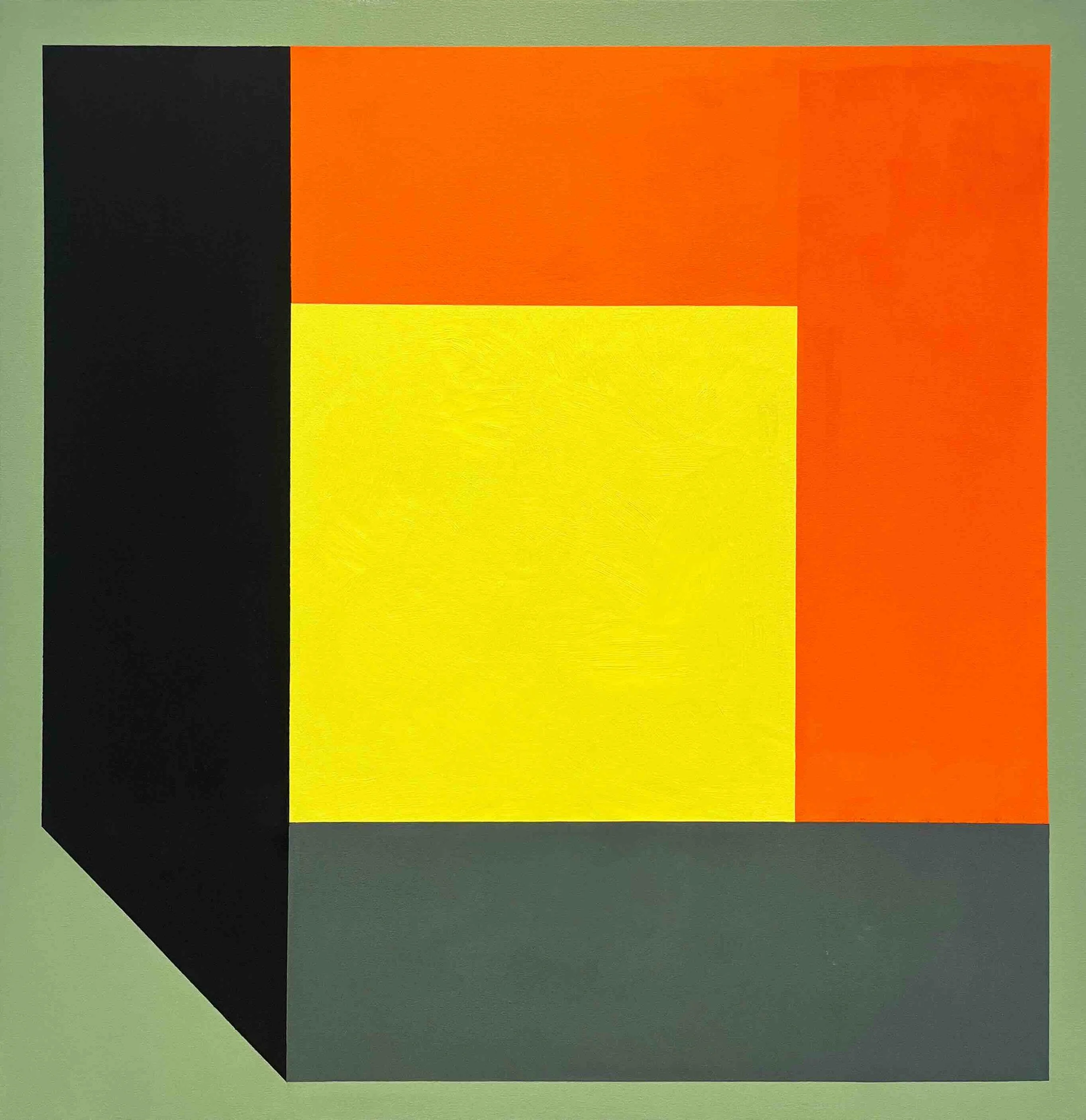
Ric believed that abstract painting was both non-fictional and fictional. Non-fictional because it reveals the process, shows physical truth—paint and canvas. Fictional by allowing the viewer's gaze to look for another truth. His painting was deliberate, always striving to communicate the clarity of its intentions. A pictorial clarity that ideally illuminated the obstacles between the viewer and the painting. "Numbers and measurements form the skeleton of my work," he wrote. "Color, line, and shape being omnipresent. My work represents those wordless spatial experiences encountered in our daily lives."

Shape and colour was his life’s focus.  Alone together looking but not discussing, Ric and wife Laura took in Barnett Newman’s “Station of the Cross” at the National Art Gallery, Washington, D.C.  Ric turned and asked ”can you see it”?  He knew - she could see it.  Her eyes read the paint while her heart produced tears of joyful recognition.  It was riveting.  Newman’s black paint applied on 15 white canvas’ was a profound, shared understanding of why a visual artist, her husband of little words, was driven to use geometric abstraction as his form of expression.

(The Stations of the Cross is a series of fifteen abstract expressionist paintings created between 1958 and 1966 by Barnett Newman, often considered to be his greatest work.)[1]

Evans studied shapes.  He drew shapes.  He had a studio with rectangular, round and square tables for drawing with a garden of colour for inspiration.  "Geometric order and measurement play a large role in our daily lives," he wrote in 2005. "Its omnipresence is everywhere. This interest and the desire to paint has sustained my work for 50 years. Because geometry plays a part in the control of everyday life, it has a symbolic role in our culture. As an artist, I contemplate this and it informs my painting."

Evans trained his eye to see geometric shapes in original ways. Hence the freshness of his work. The influences of Barnett Newman, Imi Knoebel, Frank Stella, Joseph Alder, Ellwood Kelly are evident but there is a reduced, distinct Ric Evans perspective. His specialty was color that he set within a simple geometric framework - typically evoking the urban environment—furthered by tattered edges and rough textures.

"Visual space must have color," he wrote, "and color must occupy all the visual space. I want my color to function as a factual component—sometimes chosen by its weight and presence, sometimes by its coded or representational properties. I like to paint each color in amounts large enough so that the weight and presence is fully conveyed."

He was a consummate colourist. He declared his colors individually, each independently holding its own. When he juxtaposed them, adjacent colors learned provisionally to co-exist—but not without border tensions. As important as color was the material body of the paintings themselves. Paint was variously applied, smooth or brushed onto solid supports, the larger canvases stretched over wood panels. For the smaller diptychs and triptychs, he applied paint with a palette knife directly onto birch panels.

The external shapes of these multi-panel works were idiosyncratic; it took more than a moment to realize that the panels in each set were identical. Their unpredictable internal subdivisions and eccentric colors cast even that certainty in continual doubt.

The art historian Roald Nasgaard, described one painting called “Encounter”,  a mustard-colored ground against which three sturdy rectilinear planes churn around a center core like the arms of some big industrial mixing machine.
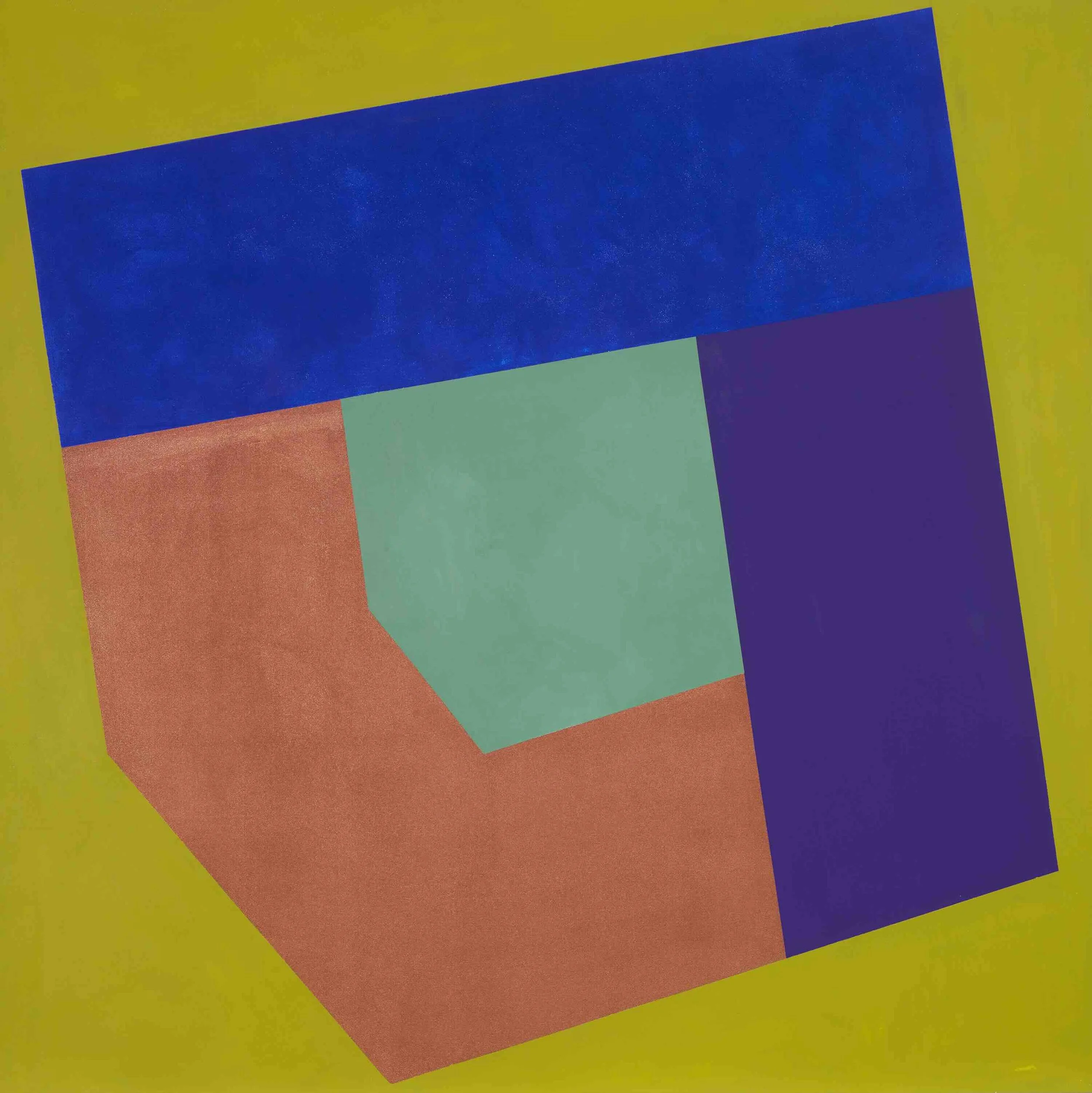
An angular, glistening copper shape in the bottom left pushes up at a luminous cobalt blue rectangle above, which in turn weighs down on a dark purple irregular rhomboid on the right, which then shoves along the original copper shape. Round and round—clockwise and counter-clockwise—in a concatenation of muscular actions that fire up our own internal mirror neurons, inundating our bodies with emphatic emotional responses. Instability was the constant state. The compositions were whole, but the eye couldn't hold them still. Imagined orders emerged, dissolved, and re-emerged.

It was, on the contrary, both exciting and celebratory. "Up-front, quirkily so, as Evans' compositional structures often are," Nasgaard wrote, "it is nevertheless when he pits structure against destabilizing contraries that his more recent painting delivers its aesthetic pizzazz."

In 2015, Evans completed a large-scale commission for Cadillac Fairview for a prominent lobby location in the West Tower of the Toronto Dominion Building, designed by architect Mies Van Der Rohe, in downtown Toronto.
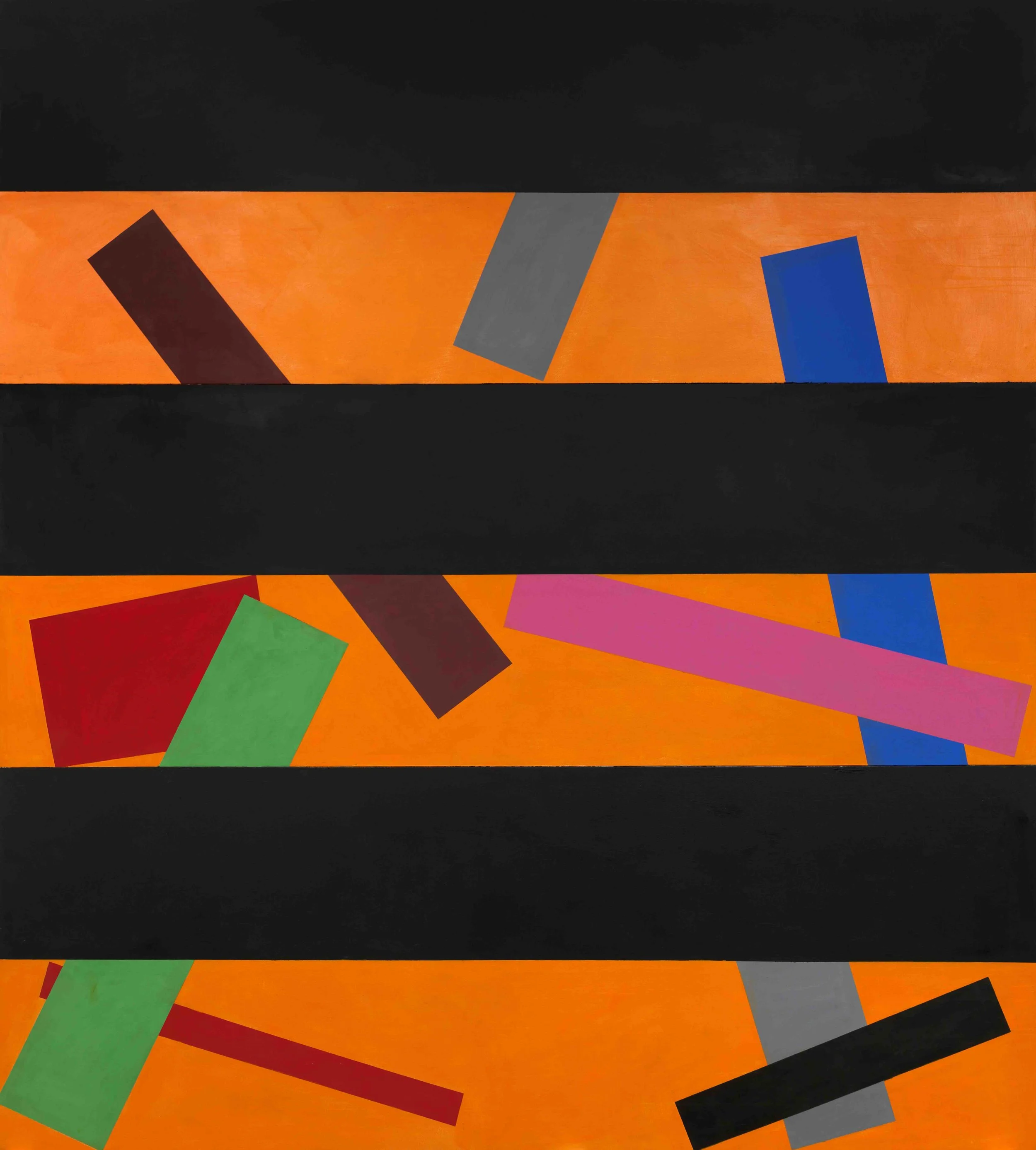
This 11’ x 10’ oil painting entitled Umbratus is a career of synthesized ideas formulating for twenty or thirty years. Ideas that would glimpse out in one study, disappear, resurface in another process until finally they cohered into something he was willing to show.Because Ric's work was fundamentally about editing. About leaving out. About showing his viewers the artistic, painterly process while withholding everything extraneous. He would put down an idea, set it aside, return, work with it again, put it aside, move on.

The flexibility of a dedicated studio space meant he could live with his ideas long enough to find out what they actually were. The studio gave him a luxury of time, of return, of revision and completion.  His practice was the studio.  The process is the studio.  The studio is where and how a person becomes a visual artist.  Artists like Evans and Poldass found studio space and created cooperative art galleries when space in Toronto was affordable and abundant.  These fortunate circumstances rarely exist in 2026 for practicing artists. The Ric Evans Estate has created Ric Evans Studio to encourage the preservation of studio spaces through donation inquiries and sales with his gallery, as an important artist’s sacred place of practice is being transformed.

Evans maintained a studio from his early twenties until his passing on August 12, 2025, at seventy-nine years old.   Ric Evans and Laura Rainey, founded Studio 201 in 1998 at the Fred Newman art studios. The 253 Niagara Street studio was his last and the longest. The mandate of the Ric Evans Estate is to showcase and share the Ric Evans Studio as it always was: a biography of the maker, holding his thoughts, his processes, a love of music and exploring the beautiful, complex and wondrous things that inspired him to make art.

The wasp's nest still hangs from the ceiling.